Agentic Workflow
Reusable Pattern
The agent roles, label state machine, orchestration, and safety rails described here are generic — they can be adopted by any OSS project using Claude Code. HyperAdmin-specific configuration (CONSTITUTION.md, review checklist, project IDs) is layered on top and clearly marked.
New here?
Start with the Onboarding guide for a quick orientation.
This project follows a 5-agent Claude Code workflow for AI-assisted open-source development. Each agent has a specific role, model tier, and output contract, orchestrated through .meta/ files (GitPM) and GitHub PR labels.
Architecture
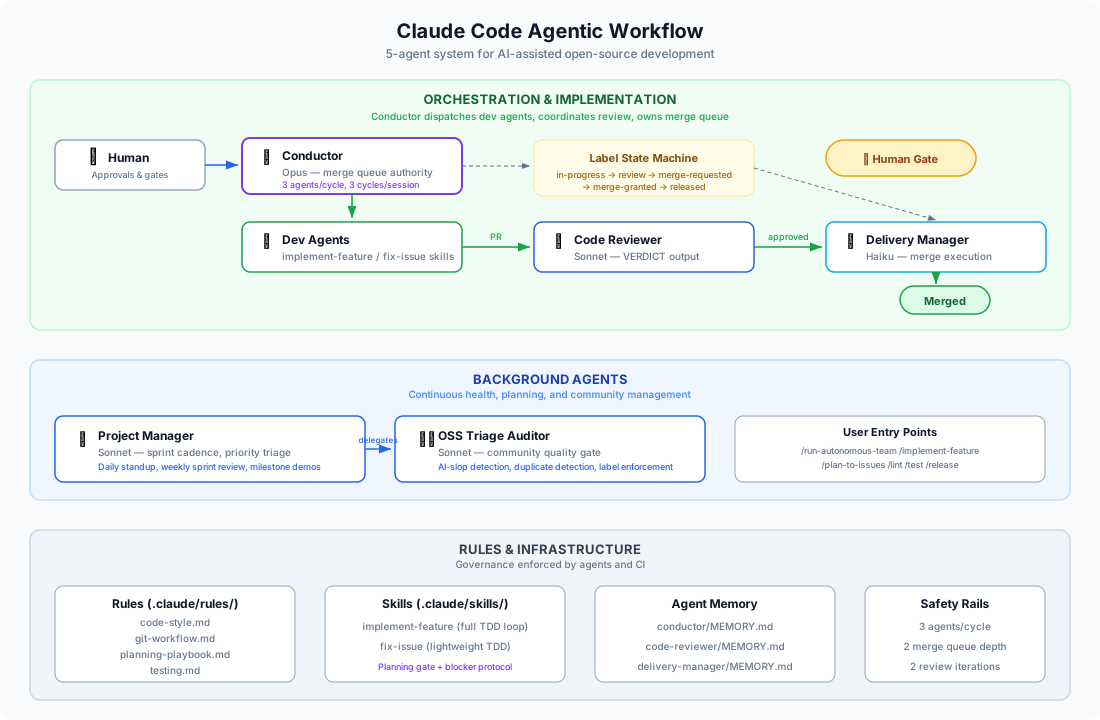
Component Relationships
Commands (user entry)              Skills (reusable workflows)           Rules (governance)
├─ /run-autonomous-team ──────→ conductor agent                         ├─ code-style.md
├─ /implement-feature ────────→ implement-feature skill ◄───────────────├─ git-workflow.md
├─ /plan-to-issues ───────────→ GitHub Issues                           ├─ planning-playbook.md
└─ /oss-triage-audit ─────────→ triage_audit.py                         └─ testing.md
                                                                              ▲
Agents (autonomous)                                                           │
├─ conductor ─────────────────→ implement-feature skill ──────── enforces ────┘
│                          └──→ code-reviewer agent ──────────── enforces ────┘
├─ delivery-manager ──────────→ merge execution
├─ project-manager ───────────→ oss-triage-auditor agent
├─ code-reviewer ─────────────→ VERDICT output (machine-readable)
└─ oss-triage-auditor ────────→ audit report
Agents
| Agent | Model | Role | Trigger |
|---|---|---|---|
| Conductor | Opus | Orchestrates team cycles, owns merge queue | /run-autonomous-team command |
| Delivery Manager | Haiku | PR monitoring, E2E tests, merge execution | Label filter (autonomous) |
| Project Manager | Sonnet | Sprint cadence, priority triage, health | Cron schedule |
| Code Reviewer | Sonnet | Architecture review against project rules | PR with review label |
| OSS Triage Auditor | Sonnet | Detect AI-slop, enforce labels, close stale | Ad-hoc or delegated by PM |
Core Principles
- Mandatory TDD: Every functional change begins with failing tests. Implementation follows.
- Bottom-Up Architecture: Models → Business Logic → Views → UI (never the reverse).
- Git-Native PM: All issue/epic/milestone state lives in
.meta/files, synced to GitHub via GitPM. - Label-Driven Coordination: PR lifecycle managed via GitHub labels — no direct agent-to-agent messaging.
- Human Checkpoints: Approval gates between planning and implementation, and before release.
Label State Machine
idea → researched → planned → approved → in-progress → review
                                                          ↓
                                    merge-requested → merge-granted → released
                                                  ↘ merge-deferred
Each label transition is owned by a specific agent or human:
| Transition | Owner |
|---|---|
| idea → researched | Deep research (Claude Opus) |
| researched → planned | Roadmap planning (Claude Opus) |
| planned → approved | Human |
| approved → in-progress | Conductor |
| in-progress → review | Dev agent (via implement-feature skill) |
| review → merge-requested | Delivery Manager |
| merge-requested → merge-granted | Conductor (merge queue authority) |
| merge-granted → released | Delivery Manager (executes merge) |
Safety Rails
| Limit | Value | Purpose |
|---|---|---|
| Dev agents per cycle | 3 | Prevent resource exhaustion |
| Cycles per session | 3 (9 issues cap) | Bound total work |
| Merge queue depth | 2 | Reduce conflict risk |
| Review iterations | 2 max | Escalate to human if stuck |
| Auto-revert | On CI failure post-merge | Protect main branch |